- Consulted 4700+ Registrations
- Free Experts Assistance
- Minimum Price guaranteed
- Quick and Hassle-Free Process
- Free Consultation on Import-Export Compliance
- 20 years experience & Serving more than 4700+ companies
- Providing one stop solution for all Annual compliances
CONTACT US
Our advisor is just a call away
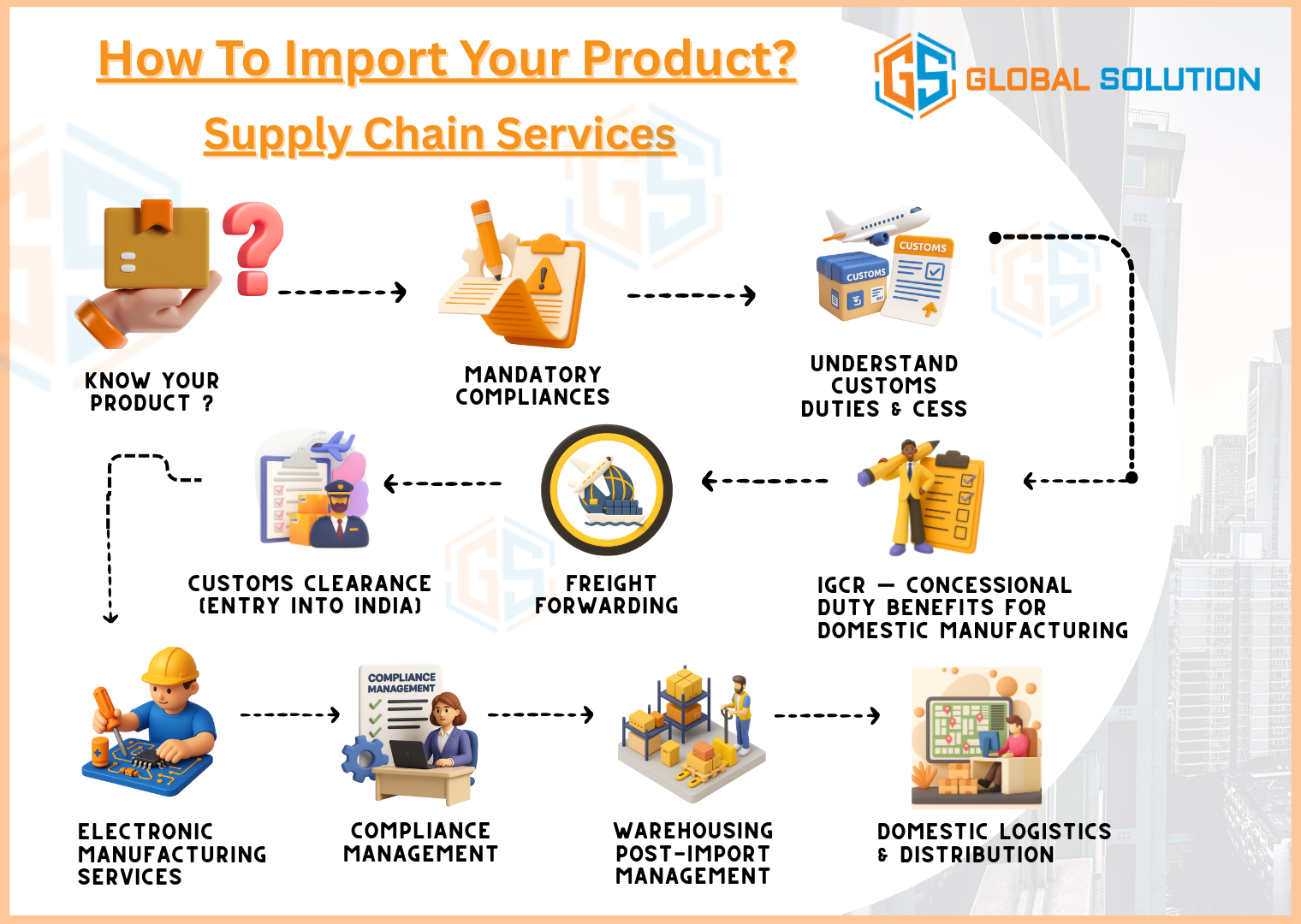
How to Import Products into India — Step-by-Step Guide
Importing products into India may seem challenging, but with a clear roadmap, the process becomes smooth, compliant, and efficient. This guide provides a structured overview for entrepreneurs and businesses planning to import goods into India safely and legally while optimising cost, compliance, and logistics.
Step 1: What does “Know Your Product” Mean before importing?
The first step is to clearly understand your product category, its regulatory requirements, and its relevance in the Indian market. Begin by identifying the correct HS (Harmonised System) code for your product, as it determines duties, restrictions, and compliance obligations.
Key Considerations:
- Market demand and competition
- Compliance with Indian labelling and safety standards
- Requirement of certifications or import permits
Step 2: Which Mandatory Compliances and Licenses are required for Importing into India?
Every importer in India must have a valid Importer-Exporter Code (IEC) issued by the Directorate General of Foreign Trade (DGFT). Depending on the product type, you may also need additional licenses — for example, BIS for electronics, FSSAI for food items, or CDSCO for medical devices.
Common Documents Required:
● IEC certificate
● Product certifications (if applicable)
● Commercial invoice and contract
● Packing list
● Bill of Lading / Airway Bill
Step 3: How are customs duties, IGST, and CESS calculated on imports?
Imports attract several duties, including Basic Customs Duty (BCD), IGST, and Social Welfare Surcharge. Some products may also incur Anti-Dumping Duties.
Why Duties Matter:
● Protect domestic industries
● Support national trade infrastructure
● IGST can be claimed as input tax credit
Accurately calculating duties helps determine the true landed cost of goods.
Step 4: What is the IGCR scheme, and how does it help to reduce import duty?
Under the IGCR Rules, eligible manufacturers can import goods at reduced or zero duty when used for manufacturing or processing within India. Registration with customs and proper utilisation tracking are mandatory for availing these benefits.
This scheme supports value addition and reduces operational costs.
Step 5: Which Freight Forwarding Method is Best for your Import Shipement?
The right freight option depends on shipment size, urgency, and budget.
Freight Options:
- Sea Freight: Best for bulk cargo
- Air Freight: Fast and secure for urgent shipments
- Courier Services: Ideal for samples and small consignments
A reliable freight forwarder ensures smooth coordination and on-time delivery.
Step 6: How does customs clearance work, when goods enter India?
Customs clearance involves filing a Bill of Entry, submitting required documents, and paying applicable duties. Customs may also conduct inspections or verifications.
Documents Required:
- Commercial invoice
- Packing list
- Bill of Lading / Airway Bill
- Certificate of Origin
- Insurance certificate
- Import permits or licenses (if applicable)
Efficient customs handling prevents delays and additional charges.
Step 7: How can Electronic Manufacturing Service Spport Post- Import Operations?
Apart from import assistance, we also provide Electronic Manufacturing Services (EMS) to support businesses with product assembly, integration, and quality testing. With our dedicated assembly setup, we manage final assembly, quality control, and product finishing to ensure seamless, reliable, and compliant production within India.
Our EMS capabilities help businesses streamline operations, reduce turnaround time, and maintain strict quality standards throughout the product lifecycle.
Step 8: Why Is Compliance Management Important After Importing Goods?
Compliance is essential for smooth and legal import operations. At Global Solution & Compliance, we manage both key types of compliance:
● Importing Compliance: HS code verification, certifications (BIS, WPC, EPR, etc.), documentation, customs requirements, and labelling standards.
● Product & Operational Compliance: Product testing, quality validation, regulatory approvals, and SOP-based compliance management.
We handle both categories to ensure your products meet all Indian regulatory requirements.
Step 9: What Are the Warehousing Options After Import Clearance?
After customs clearance, goods may be stored in bonded or non-bonded warehouses.
● Bonded Warehouses: Allow duty payment deferral
● Non-Bonded Warehouses: For goods ready for domestic distribution
Warehouse Services Include:
● Inventory management
● Quality checks and labelling
● Repackaging and order fulfilment
Strategic warehousing helps minimise transit time and overall logistics cost.
Step 10: How Does Domestic Logistics and Distribution Complete the Supply Chain?
Once goods are warehoused, a reliable domestic logistics plan ensures timely delivery across India. This includes road, rail, and air transport, coupled with streamlined last-mile delivery.
Efficient distribution enhances supply chain visibility and operational performance.
Best Practices & Risk Management
Importing involves multiple variables—supplier reliability, compliance timelines, shipping delays, and documentation accuracy.
Pro Tips:
- Verify HS codes before shipment
- Keep all documentation organised
- Conduct supplier audits and quality checks
- Stay updated with customs regulations and duty changes
Working with experienced logistics and compliance partners reduces risks and ensures a smooth import journey.
Conclusion
Importing products into India becomes much easier when you follow a structured, compliant approach. From obtaining IEC and understanding customs duties to managing freight, EMS support, warehousing, and logistics—every step contributes to a successful import operation.
At Global Solution & Compliance, we provide complete end-to-end support, offering all the above solutions, SOPs, and management services to ensure a smooth, compliant, and hassle-free importing experience for your business.
Our Partners
We believe to build a strong network of clients and to serve the eco-system with mutual benefits. Some of our esteemed clients are: